Sunday, May 24, 2015

Carriacou, Grenada


DSCF1454

Hydrofoil kite-surfer in Clifton Harbour, Union Island. Note the “fin” that keeps the board 3 feet above the water.

On Monday, April 20, we sailed out of Union Island’s Clifton Harbour for a glorious 7-mile sail to Carriacou island, part of the country of Grenada. We anchored in the big bay at Hillsborough. With just a few other yachts and a handful of local fishing boats, the bay was pretty serene, except for the endless squabbling of a flock of seagulls exercising squatters’ rights on a nearby skiff.

DSCF1467

We dinghied ashore the following morning to check in, and found the tiny Immigration office having a busy morning, as the captain of a newly-arrived Danish Merchant Marine training ship had come in with about 100 passports for her crew and cadets.  “Danmark” at 252 feet long, is a majestic 3-masted square-rigger. launched in 1933.  She came to America for the 1939 World’s Fair, but stuck around afterward, as with the outbreak of WWII, concern regarding  German mines in the Atlantic made it imprudent to return her to Denmark. When Pearl Harbor brought the conflict to American shores, Denmark offered to loan the ship to the Yanks. The US Coast Guard thought that this was a swell idea, and she became USCGC Danmark, a sail-training ship.  After the war, the USCG procured a German tall ship, the “Eagle”, to use in USCG sail-training, and “Danmark” went back home.

DSCF1471

The Danish sail-training ship “Danmark” carries 18 crew and 80 cadets

DSCF1468

Danmark dwarfs the more petite Sand Dollar

DSCF1460

Some of “Danmark”’s 80 cadets on shore leave in Hillsborough town

The following day saw the arrival of another square-rigger, the 3-masted tall ship “Picton Castle” (home port Nova Scotia), and our bay was now looking very Horatio Hornblower-ish.  Built in 1928 as a Welsh trawler, this 179-foot barque carries a crew of 12 and up to 40 “sail trainees”.  The trainees, of both sexes and all ages,  paid for an around-the-world voyage (July 2014 to May 2015), during which they learn sailing skills and stand watches. They can opt for one or more legs of the voyage, or the entire trip can be done for $39,000 Canadian.

DSCF1470

Picton Castle. Her galley is actually on deck, visible here between the second and third masts.

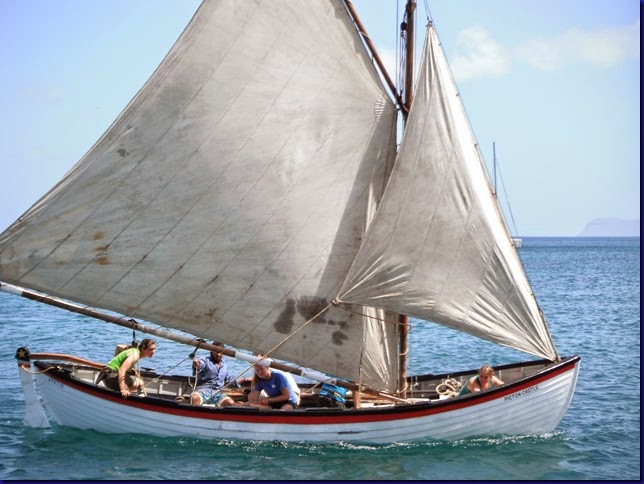
One morning they stepped a mast onto their tender (called a jolly boat), hoisted sail, and pottered about in the bay for a while. We were delighted when she made a close pass by SD; so close, in fact, that she made brief but harmless contact.
 DSCF1472

Some crew and passengers from “Picton Castle” out for a day-sail in the jolly boat

DSCF1475

Close encounter of the maritime kind!  We fended off without incident, and it made for a great photo-op!

We took a little mini-bus one day to the town of Windward on Carriacou’s NE coast. This quiet little village has long been the center of  traditional boat-building, and there were several works-in-progress under the palm trees on the day of our visit, with the sweet smell of fresh-cut lumber in the air.

DSCF1478

Boat being built the traditional way at Windward, on Carriacou’s NE coast

DSCF1479

At Windward

DSCF1482

The view NE from Windward, looking across the channel to tiny Petite Dominique (R) and Petite Martinique (L)

That Saturday, Hillsborough’s Main Street was the site for the second day of the Carriacou Maroon Festival, a 3-day event featuring traditional food, drums, stringed instruments and steel-pan music. (Maroon people are descendants of African slaves.) We’d been looking forward to some island music, but the actual event was something of a disappointment.  The musicians and singers were entertaining enough, but they were all bunched up together under a modest pavilion-style event tent, in the parking lot of a bank. Attendees stood on the periphery in the full blaze of the scorching midday sun, squished together, 4 and 5 deep, which completely blocked the view for vertically-challenged Katie. Too much crowd and heat and glare for us, so we paused briefly and moved on.

DSCF1485


DSCF1483

SD’s captain, limin’ (hanging out & relaxing, pronounced “lime-in”) at La Playa Beach Bar in Hillsborough.

After 10 days, we took another mini-bus ride, this time to Tyrrel Bay, where Carriacou Marine has a tiny marina and a small but well-run boatyard. Adjacent to the yard is the Slipway restaurant, where yachties gather on Wednesday afternoons to play “train dominoes”. We had a terrific lunch, and when the meal service stopped at 2 pm, the domino games began. We newbies were warmly welcomed and were given some basic instructions, and we quickly became addicted to this easy-to-learn game, returning the following Wednesday to practice our still-marginal skills and strategy.

Fresh tradewinds had been blowing through the anchorage for days, and the katabatic effect resulted in big gusts howling down the mountains into the bay, heeling SD as she lay at anchor under bare poles. We experienced some rather inconvenient rolling when a swell worked its way into the bay, and with the winds predicted to increase, we weighed anchor.  After an outstanding sail down to calmer Tyrrel Bay, we tacked our way into the anchorage and dropped the hook. Tyrrel was windy, too, but the bay is more protected, and the water was calm and swell-free.

Tyrrel Bay was home to a whole bunch of yachts, and whereas in Hillsborough we’d been one of 3 or 4, here we were in the company of two dozen other boats. A long clean sandy beach rings the bay, backed by shady clusters of machineel and almond trees. If we’re walking into the shops from where we’ve beached the dinghy, we can forego the hot asphalt of the little road, opting instead for a barefoot stroll on the sand, with tiny wavelets washing over our feet.

At the north end of the bay is a mangrove swamp, part of a protected marine park. No yachts are permitted in the mangroves, except in the emergency event of a hurricane. It’s perfect for a dinghy, though, and Katie enjoyed rowing in the peaceful stillness, reminiscent of the mangrove creeks of our home waterways. The pretty channel was wide enough for Ken to sail the dinghy downwind to the end of the run, and then tack his way back east to the bay. He often took the dinghy out for long sails across the big open bay, sometimes joined by a few other local dinghy-sailors. We are proud to say that Loose Change and her captain were the front-runners, performance-wise!

DSCF1488

DSCF1487

Swells are rare in the bay, and SD bobs quietly at her anchor, with seawater lapping gently at her hull. Overhead are heard the frequent calls of laughing gulls, named for the sound of their cries, rather than for their sense of humor. We toss them scraps of stale bread, and once one gull spies the bounty, he sets up such a ruckus that he is promptly set upon by the entire gull community. While it might seem altruistic for the initial bird to alert his compadres to the feast, the fact is that these birds are not into sharing, and when the throng arrives, they all commence to fight over the spoils.  We can’t figure out why he who finds the treat doesn’t just quietly scarf down the goodies before the others catch on, but there you have it.

The hills ashore are dotted with homes and tiny villages, where big plantations once owned by French settlers in the 18th and 19th centuries have since been divided into small parcels of land. Descendants of the African slaves on those plantations now have little farms and gardens on that land, and some of them bring their produce to town to sell once a week, setting up roadside tables. We’ve had fantastic salads of arugula, romaine, and other lettuces, plucked fresh from the earth just hours earlier. As nautical as the bay is, so is the actual land of Carriacou pastoral. Sheep and goats aplenty roam at will, chickens cross the road (never mind why), and roosters crow at all hours. The rooster closest to our anchorage actually makes a sound less like a rural wake-up call than that of someone being strangled, but we give him points for trying.

We’ve had a terrific time during our month in Carriacou and made some great new friends, and now we sail for Grenada in a few days. Sand Dollar and her rigging are covered in a thin film of red Sahara dust, and all the Windward Islands are crying for rain. There’s precipitation in the forecast, and with a bit of luck, we’ll get a nice boat wash from Mother Nature real soon. Grenada is known as “The Spice Island”, and her spice and cocoa plantations and her rum distilleries are calling to us! See you there!

Cheers and beers! K and K

To see where we are, go here

SandDollar_N4KS@yahoo.com

ssca_button1

Wednesday, April 15, 2015

Island-Hopping


Dear family and Friends,

Before departing Bequia on the day before St. Patrick’s Day, we took on a delivery of ice, and then sailed out of Admiralty bay into the Caribbean Sea. Beam-reaching under “jib and jigger” (headsail and mizzen), we had a bumpy 21-mile ride under clear skies in five-foot seas, with 18 knots of wind, and arrived at the island of Canouan (“can’-oo-ahn”) four hours later.  In island-style celebration of our arrival, we lunched on sweet juicy mangoes, and sipped cold pina coladas at sundown. As a further evening treat, we were witness to a beautiful “green flash” at sunset. A “blink and you’ll miss it” show, this optical phenomenon occurs when atmospheric conditions cause the final sliver of setting sun to flash green as it sinks below the horizon. To see it, you need a clear horizon, and some say that a tot of rum helps. (Worked for us!)

canouan 005

Of all the places to anchor in Canouan’s big bay, this French flagged charter cat chose to anchor right on top of ours (note our anchor marker floating under the cat). As our friend Ray on Yacht Horizon would say, “what can you do?”.


The northern part of Canouan has been developed into a gated community, complete with golf course, but our  anchorage in Charlestown Bay, on the southwestern portion of the island, off of the village, was decidedly low-budget. There’s one large nearly-empty luxury resort surrounded by colorful botanical gardens, with a dinghy dock that offers a landing site safe from the rough surf that hammers the crescent of sandy beach. The Tamarind Beach Hotel may have looked empty, but it was well-staffed, and its little deli shop was stocked with gourmet goodies, primarily Italian imports. We were unable to resist, and splurged on some cheese and a fresh crusty baguette. 

canouan 003

Charleston Bay, Canouan Island

On our strolls through the little village, we noted lots of sheep and goats, but no tourist-oriented shops or businesses, and every person we passed greeted us with smiles and hellos. An abandoned dinghy in a field provided a playground for some young goats, who butted heads in mock fierceness, and jumped in and out of the dinghy, looking for all the world like the goat version of 9-year-old boys.

canouan 006

Besides goats, there were plenty of sheep wondering around too!

We happened upon a mom-and-pop eatery, situated on the first floor of what appeared to be someone’s home. The tiny dining area was spotless, simply but attractively decorated with colorful tablecloths and little vases of flowers. The place appeared to be run by the two women who did the cooking, and our lunch, eaten on the shady, breezy porch, consisted of generous portions of fresh fish, salad, rice, stewed green vegetable, and breadfruit. It was cheap, delicious, and a welcome change from tourist-oriented menus and prices.

 canouan 001a

Stewed fish, breadfruit, spinach, rice & peas, salad. A lot of food for $6.

We renewed our Grenadines 30-day visas, and after a week weighed anchor for an 8-mile motor-sail to the Tobago Cays National Maine Park. (Not to be confused with Trinidad and Tobago.) This cluster of five tiny uninhabited islands is sheltered from the open Atlantic by big, appropriately named, Horseshoe Reef. The palette of gorgeous colors in the water ranges from gold and brown over the reefs to turquoise, green, and blue over the sandy spots, making the stunning, pristine waters a hugely popular destination.

DSCF1419

The “herd” at Tobago Cays

The park is also a sea turtle sanctuary, and is a popular snorkeling, scuba diving, and turtle-watching site. One of the five islands, Petite Tabac, was the location for filming the desert island scene in the first “Pirates of the Caribbean” movie, and its beach and coconut trees were readily recognizable through our binoculars.

DSCF1420

Petit Tabac, Tobago Cays

When we arrived at the Cays, the anchorages were crowded with dozens of yachts and charter vessels, and numerous little open local boats zipped among them, hawking fish, snorkel tours, or whatever. It all gave the area a “theme park” atmosphere that was not much to our liking. Away from the most congested areas, we managed to find a secluded spot with only one other anchored boat. Despite the protection of the reef, we spent a windy, bumpy, roll-y night, and so the next morning we weighed anchor and moved three miles west to Saline Bay on Mayreau island, which is still part of the National Marine Park.

Saline Bay proved to be an ideal anchorage, the water calm and clean, with a long stretch of pristine sandy beach a short dinghy-row away.

DSCF1430

Saline Bay, Mayreau Island, Grenadines (Union Island in background). SD is at top center.

The island’s single unnamed village has one very steep road, along which we found a few open but empty restaurants, and a single mini-market.

DSCF1429

Mayreau Island local showing the captain how to spin bottle caps.

DSCF1427

Local bar/restaurant, owned by Rastafarian “Righteous Robert”, in Saline Bay, Mayreau Island

We ordered lunch one day at one of these places, and were served an outstanding lobster-salad sandwich, with a couple of ice-cold beers.  The island’s only drinking water is rain-caught, and electricity was not introduced until 2003. Unfortunately, the islanders have yet to come up with a workable solution to the trash. Once away from the beach, litter lined the road, and although we happened upon a burn pit along a dirt trail in a secluded area, it was obvious that this was only a half-hearted attempt to manage the problem. Too bad, as the pretty anchorage attracts a fair number of boats.

Four days later we sailed a few miles further south to Union Island, anchoring in secluded Chatham Bay. This big breezy bay is accessible only by boat, or by a long and arduous trip over the mountains on a road that is only partially paved. Yachts anchored here have blissful seclusion from any commercialism. A couple of beach shacks offer fish or chicken BBQ if you order it the day before, presumably so that they can order the fixin’s from wherever, but we opted to save our money and dine on board, sipping our rum and watching for more green flashes.

We spent a few days there, took the dinghy for a row, had a stroll on the long empty beach, and then moved  a few miles around Union’s SW corner and dropped our hook in the lee of little Frigate Island, which is essentially a tall, foliage-covered rock.  From our cockpit we could watch numerous kite-surfers flying back and forth over the chop. Tiny non-touristy Ashton village, at the head of the bay, had friendly residents who stopped to chat, cheap rock-hard block ice, tasty local food, and the best rum raisin ice cream we’ve ever eaten. In the large hillside cemetery, a handful of goats defiled a fresh grave by chowing down on the funeral flowers heaped on top of the dirt.  We called out to them that they were being rude, but their rudeness extended to ignoring us.

An inexpensive mini-bus provided transport to Clifton, Union’s main town, with its shops, markets, restaurants, tiny airport, and kite-surfing school. The day after Easter we rode in and stumbled upon the tail end of a festival called a “j’ouvert” (which the locals pronounce “joo-vee”).  The word derives from the French, meaning something like “to open”, and it “opens” the day, beginning around 4 a.m.  Lonely Planet describes it as “a no-holds-barred pre-dawn street party”, where revelers file into the streets and let loose, slathering themselves and others with paint, and sometimes mud, oil, or even liquid chocolate, while imbibing significant quantities of alcohol and listening to maximum-decibel music. (We were in Thailand for similar paint-and-water-splashing festivities some years ago, during their Songkran festival, but there they omitted the hip-hop music. Thank goodness.)  Unaware of this social phenomenon when we boarded the bus in quiet little Ashton, I thought that the young man squashed in beside me must have been suffering from some dermatological disorder, as smears of dried pink calamine-looking stuff covered his arms and face. Fearing contagion, I leaned as far away from him as I politely could manage, practically climbing into Ken’s lap, but I guessed from the strong alcohol fumes of the guy’s breath that he was oblivious to my aversion.

Arriving in Clifton, we found ourselves in the thick of it, even though the party was winding down. Painfully loud island hip-hop music blared from speakers the size of phone booths, at a volume that hurt not just my ears, but also my teeth. Not even bands like Metallica achieved these decibel levels! Paint-smeared party-ers of both sexes, some in advanced stages of  inebriation, happily wandered the streets clutching their beverages and shouting out to each other. Almost everything was closed, so we didn’t linger long, but it was quite the memorable experience.

After a several days in Frigate Bay, we moved SD over to the harbor off of Clifton, anchoring in the colorful gin-clear water behind the big reef that protects the harbor. SD floats with her bow into the prevailing east wind, facing the reef, and we can sit on the foredeck and enjoy the entertainment provided by kite-surfers zipping past.

DSCF1444

Clifton’s harbor, Union Island

On the south edge of the reef is a remarkable little island called Happy Island. Its owner, a pleasant local fellow named Janti, created his own island by hand. Taking conch shells from the huge piles that are a common sight on the beaches, he built an island, cemented it over, then covered it with sand and built a bar on it. Power comes from wind generators and solar panels, and he lives in a house attached to the back. Dinghy right up to the island, and enjoy a frosty beverage, poured over ice or whipped up in a blender, as were our favorite rum drinks, “Pain-killers”.  The place has gained quite a bit of fame, and a Travel Channel segment even featured a visit by Anthony Bourdain.

DSCF1435

Happy Island

DSCF1442

An excellent dinghy dock at Clifton’s harbor

On the recommendations of our cruising publications, we splurged on a couple of restaurant meals ashore, both of which turned out to be well worth the money. One of these was a lunch of lionfish, an exotic and colorful predator that is stripping the reefs of the native fish.

DSCF1450


DSCF1447

Yummy Lion fish.

It is speculated that this species found its way into the Atlantic via the tropical aquarium trade, and since the native fish don’t eat them, they are proliferating. The islands have mounted an “eat them to defeat them” campaign, or as one source calls it, “the revenge of the knife and fork”, and it helps that they are absolutely delicious, a white flaky fish similar to cod or snapper. We did our part, and found our meals, one grilled, one with lemon sauce, to be as good as promised.

DSCF1451

Colorful Clifton markets (above and below).

DSCF1453


 DSCF1431

Besides our sun awning, which doubles as a rain catcher, we sometimes utilize this one rigged on the bow.

With the clock ticking on our Grenadines visas, we’ve plotted a course for Carriacou (“carry-a-coo””) island, seven miles south, which is part of the country of Grenada and is the last island before our sail to Grenada itself. We plan to hang out in Carriacou for several weeks, as there is lots of great stuff to see, new rum to sample, as well as some of the famous chocolate from Grenada.  We don’t want to miss a thing!

Cheers and beers! Katie and Ken

SandDollar_N4KS@yahoo.com

ssca_button1


Sunday, March 15, 2015

Ken and Katie’s Excellent St. Vincent Adventure


About 9 miles north of Bequia’s Admiralty Bay lies the island of St. Vincent, which together with the Grenadines makes up one country, usually just referred to as SVG. A sail there from Bequia is not a pleasant passage, as yachts have to tack to windward against a foul current.  Its capital city, Kingstown, has poor facilities for yachts, and would-be cruisers are advised to guard their boats. Our “Windward Islands Cruising Guide” remarked that most yachties visit Kingstown by road or ferry, and with multiple ferries departing Bequia daily for the one-hour trip, we decided to go that route.

DSCF1395

We boarded the Admiralty II at 0900 and commenced a very roll-y ride, bashing into high, confused seas and a howling wind. A little 8-year-old girl seated across from us lost her breakfast into a plastic bag held by her mother. She recovered quickly, however, and by the time we pulled into the calmer waters of Kingstown Bay she was munching on some dry cereal.

We had arrived in Kingstown on market day, when farmers from the hills bring their produce to the city, and the sidewalks were crammed with tables holding an assortment of farm-fresh fruits and vegetables, as well as some flea-market type assortments of toiletries, sunglasses, and beaded necklaces.

As we walked along, we were greeted by a local gentleman who said that he’d seen us in Bequia, boarding the ferry. He told us that he worked in a Bequia hotel, but was originally from St. Vincent, and had come to do some shopping. He explained that all the produce in Bequia was brought over from St. Vincent, and that a 2-pound bag of tomatoes that cost $4 EC in Kingstown would cost $12 EC in Bequia. (His estimation of the Bequia price I had found to be true.)

He joined us as we continued walking, describing local places of interest, and pointed out the best restaurant (“for real St. Vincent food”) for lunch.   He talked pretty much non-stop, but we only got about 75% of what he said, because his enunciation was affected by his heavy island accent and a total absence of teeth. We told him that we’d like to take the bus to Wallilabou, which in 2002 was the site for the filming of various parts of the first “Pirates of the Caribbean” movie. It has a picturesque little bay, which we wanted to check out as a possible overnight stop for our northbound voyage next year.

As we walked to the bus station, we passed a man selling drinking coconuts from a truck, and our “guide”, Gordon, asked if we’d like one. We said yes, but the coconut man wanted to charge us the $5 US “tourist” price, and Gordon insisted that since he as a local was ordering it for us, we should only pay the $2 EC “locals” price (a little less than $1 US). A bit of unintelligible (to us) haggling began and in the end, we paid the “locals” price, but it was obvious that the vendor was none too happy about it.

DSCF1409

We continued on to the bus station, which turned out to be little more than a big parking lot, with a lot of small vans about the size of small airport shuttle vans. There was no apparent signage, and Gordon just asked a couple of drivers until he found one who was headed toward Wallilabou.  Having located the right “bus”, Gordon proceeded to board with us, and we began to realize that his help was probably not motivated by a spirit of altruism, and we suspected that he was going to expect some financial return for his assistance.  More than once he made a point of commenting that by our being with a “local” (i.e., him), people would not take advantage of us, but would charge us the same prices as they did locals. Having encountered this type of unsolicited helpful individual before, in the Philippines and in Morocco, we have learned to recognize the signs.

Boarding the “bus”, Gordon directed us to sit in the back, where we would be able to see out the window. I obediently took the far right corner rear seat, and Ken climbed in beside me. The driver was waiting until the bus was full before we left, but once all the seats were taken, he lingered on, apparently intending to cram in as many bodies as possible. There were three 2-person seats behind the driver in our bus, and one three-person bench seat in the back, but more and more people kept climbing in, and little “filler” seats were added, until, finally, 21 of us were shoe-horned into the little van. The driver pulled the bus into a small queue of similar vehicles, where there ensued some prolonged and inexplicable horn-blowing for about 10 minutes.

DSCF1396

Finally, we were off, rocketing through the narrow crowded city streets, dodging pedestrians and other vehicles. As we exited the city, we began a white-knuckled (for us – no one else seemed to mind) ride as the driver navigated the steep, narrow, twisting road up into the mountains and back down into the valleys at what felt like warp speed, while high-energy (and high decibel) nightclub dance music played continuously over the speakers. There were no seatbelts on the bus, but it was a bit of a moot point, since we were wedged in so tightly that even if the thing had capsized, we would have stayed in our seats. Whatever suspension the vehicle hay have had, it was no match for the uneven pavement and the aggressiveness of our driver.

It began to rain pretty hard, so despite our window seat, we couldn’t see much, which was probably just as well, since we were frighteningly close to the edge of the rain-slick road, beyond which steep ravines dropped hundreds of feet.  We careened past stark, unattractive industrial complexes, then past some residential areas where modern homes mingled with sad, thrown-together shacks which were little more than skeletal lumber frames patched with bits of tin and plastic sheeting. We saw one rum shop with the hand-lettered name of  “Slap Me Up Bar”.

We finally arrived at Wallilabou, which appeared to be not so much a town as merely a bend in the road. We disembarked, and at a sign proclaiming “Wallilabou – Home of the Pirates of the Caribbean” we walked down a short steep road to the remnants of the old movie set.  The buildings there have pretty much fallen into disrepair, but are optimistically done up in swashbuckling style to capture the spirit of the movie.  Some of them held displays of actual daily shooting schedules, cast and crew photos, stills from the film, and a few pieces of clothing (not from the movie) for visitors to wear for pirate dress-up photos.

DSCF1398

DSCF1399

We did see a couple of genuine recognizable items from the film: the stone arch where hung the remains of three lynched pirates, seen as (“Captain”) Jack Sparrow first arrives, is easily visible at the north end of the bay. (Minus the three dead bodies.) And inside the big roofed open-air wooden restaurant is the actual mast used in the movie from which Jack steps onto the dock at Port Royal. The dock itself is still there, although it was shortened by a hurricane in 2005.  The bay itself is small, pretty, and well-protected, occupied on the day of our visit by about five or six boats at anchor.

DSCF1401

DSCF1403

We strolled and looked for a while, and met a local man selling beaded bracelets and necklaces (“This one is like the one Kiera Knightley wore in the film”), who told us that he’d been one of the locals hired as extras in the movie. 

Gordon had by now managed to corral a young couple with British accents and bright pink sunburns, and he herded the four of us up to the main road to walk to a popular waterfall. We walked uphill on a fairly gentle grade for about half an hour, seeing almost no passing cars. The walk was quite pleasant, the road running alongside the river where local women come to do their laundry. We in fact passed one lady walking home with a large basket of wet laundry balanced on her head (no hands!). There were no homes along this stretch, but thick vegetation on the right, greenery-covered mountains rising on our left. Gordon narrated as we walked, plucking pea pods from a bush for us to shell and sample the peas (sweet), and pointing out a nutmeg tree and the ruins of an old arrowroot mill. I said “Hello, goat” to an animal that was tethered at the roadside, whereupon Gordon politely pointed out that it was a sheep.

DSCF1404

DSCF1407

When we arrived at the waterfall there turned out to be a fee to go see it. Our British companions, unaccustomed to the heat and humidity, were happy to pay the fee and cool off in the falls. But having seen numerous waterfalls and being too cheap to pay a fee, Ken and I declined. We were also beginning to be concerned about the time, as we hoped to catch the 4 pm ferry back to Bequia.

So we started back down the hill with Gordon trailing in our wake, tripping over his flip-flops and occasionally walking right out of one, necessitating a pause while he stopped to retrieve it.  A short distance past the little access road to POTC we were able to flag down a bus to Kingstown. This one was as crammed as the first one, and the driver was every bit as lead-footed and aggressive. The ride home was under clear sunny skies, so we had the added terror of being clearly able to see how close we were to the non-existent shoulder of the road, where hundred-foot drop-offs appeared as we rounded the hair-pin turns at breakneck speed. Why we didn’t all end up in a mass of twisted metal and broken bodies in a ravine far below remains a mystery. But we didn’t.

Certain beyond a shadow of a doubt that it was expected, Ken offered Gordon some compensation when we arrived back at the bus station. Some conversation ensued which I couldn’t make out, but then Ken handed Gordon $100 EC (about $37 USD), which seemed to me to be quite generous. Gordon evidently didn’t think so, and began to plead his case, extolling his skill as a tour guide and the benefits of his companionship, i.e., getting us “local prices” for bus and coconut.  Anxious by now just to get rid of the guy (and he had, in fact,  been quite pleasant and helpful), Ken gave him a few more bucks, and we shook hands and parted company.

We set off to get some lunch, relieved to be spared the somewhat exhausting task of trying to understand Gordon’s non-stop, toothless, accented, machine-gun prattling. Heading in the general direction of the aforementioned café for “real St. Vincent food”, we kept an eye on the names of shops and eateries we passed, watching for the right one. For some mysterious reason, twice, when locals saw us looking at store-front names, they pointed ahead and said, “It’s further up”. As it turned out, they were right, but without our having uttered a name, how did they know where were going?

Anyway, lunch was delicious:  overstuffed fish roti with fresh cabbage salad and a couple of cold beers. Thus fortified, we did a bit of shopping at the hardware store and grocery, and bought a big bag of assorted fresh produce from one of the market ladies, paying $34 EC for what would have cost more than $100 EC in Bequia.

We treated ourselves to another cold beer at the ferry terminal, and after a relatively calm and anticlimactic ride home (nobody threw up), we at last arrived back in Bequia. The end.


Next stop: Canouan Island

Monday, March 9, 2015

Beautiful Bequia


We are quite pleased to have chosen Bequia (Bek-way), the largest of the Grenadine islands, as our first landfall following our Atlantic crossing. Lonely Planet describes this 7-square mile jewel as “the most perfect island in the whole Grenadines”, and its charm and appeal are immediately apparent. There is plenty of room in big, well-protected Admiralty Bay, where several dozen boats bob on moorings or at anchor.  The water, in colors ranging from palest blue to turquoise, azure, and cobalt, is clear, clean, and warm for swimming. Low hills full of greenery provide a scenic backdrop.  Ferries, yachts, water taxis, and the service boats that deliver water, fuel, and laundry criss-cross the bay and provide entertainment as we enjoy our morning coffee or evening sundowners in the cockpit. Additional evening entertainment occasionally reaches our ears as we hear the sounds of steel-pan music from shore.

DSCF1391

Admiralty Bay

Once we’d picked up our mooring and negotiated a long term deal, we made coffee, off-loaded our grubby passage laundry to the service boat, rowed to the closest little dingy dock, about 100 yards away, and walked into town. Charming little Port Elizabeth, Bequia’s only town, is not much more than a series of shops, markets, and cafes rimming the beach around the bay. After stopping at an ATM for some local currency, we checked in with the friendly Customs and Immigration officials, then wasted no time in sampling some island cuisine. Before lunch we took a table at the Gingerbread Café for a couple of cold bottles of the local beer, Hairoun, which the locals call “Hold Your Own”. While we “held our own” first cold beers in over a month, we took advantage of the WiFi to catch up on our backlog of e-mails. Then we were off to the Porthole café for some serious food. The conch roti, the burger, and the rum punch were a huge treat after 30 days of “boat food”.

DSCF1392

Port Elizabeth

Roti are a Caribbean specialty, generous bundles of meat or fish in a spicy curry sauce with cubes of potato, all wrapped in a paper-thin wheat-flour tortilla. During our stay in Bequia we also tried some local “jerk chicken”, which, while not as juicy as our American birds, was deliciously seasoned and grilled. From a Trinidadian sidewalk vendor we bought “doubles”, a Trini specialty of excellent curried chickpeas sandwiched between thin fried pancakes. Messy and tasty, and a bargain at $4 EC each (about $1.50 US). And even though they are not yet in season, the mangoes we bought were sweet and juicy.

DSCF1393

“Hot, tasty doubles”, says the sign. And they are!

We divided our time between tending to SD’s post-passage needs and exploring our new digs. Ken scraped a big crop of goose-neck barnacles off SD’s bottom, and spruced up her stainless hardware, while Katie scrubbed the cabin sole and did a major wipe-down in the cabin. Despite having been on the open ocean, the wind had managed to deliver dust and super-fine sand to our interior all the way from the Sahara.

For such a small island, Bequia boasts a significant number of skilled craftsmen and chandleries. We found a replacement for our boat hook at one of the chandleries, got some stainless steel welding done on our windvane, bought a new solar panel regulator and got our headsail re-stitched. We’ve also managed to significantly reduce the island’s rum inventory.  We are certainly helping out Bequia’s economy! 

We made frequent forays into town, where colorful local fishing boats are pulled up onto the beach in front of the bars and cafes. Fruit stands, open-air markets, cafes, and craft shops line the waterfront walkway, and beside the beach, local artisans tend a little row of tables, hawking their their wares under shady trees.  From the island’s earliest days, boat-building has been at the heart of the island’s economy, and beautifully hand-crafted model boats are for sale, along with beaded island jewelry, imaginative coconut carvings, and colorful hand-painted bowls made from calabash (a type of gourd). 

The people are unfailingly smiling, friendly, outgoing, and eager to help. The Rasta guys at the fruit market wave and call out greetings when we pass, even if we’re not buying that day, and the staff at several cafes greet us like old friends. Bequians descend from North American whalers, Scottish farmers, French freebooters, and African slaves, and English is the main language, spoken with a musical island lilt.

Whaling was once a major occupation here, and some of the island’s residents are descendants of New Bedford (USA) whalers who arrived in the 19th century and taught the skill to locals. Under stringent International Whaling Commission restrictions, whaling is still permitted here, when the humpbacks arrive from the north around February to breed. But there are very few whalers left with the skills to hunt them – a daunting and dangerous feat in an open sailing boat, with hand-thrown harpoons.

DSCF1394

Fresh baguettes (from French Martinique) delivered right to your yacht!

DSCF1382

During calm conditions on our Atlantic crossing, our light weight spinnaker made the difference between the boat’s moving or not moving.

DSCF1385

One of the calm, squally days we encountered during our crossing of “the pond”.

DSCF1375

Pre-passage in Puerto Calero, Lanzarote – ready to go and looking forward to warmer temps.!

From here we’ll head south towards our ultimate destination, Grenada. We are looking forward to the trip, because there are many islands, all within reach of day sails, to explore along the way. Before we depart Bequia, we plan a day trip to nearby St. Vincent on the ferry. But that will be another story!

Cheers and beers!  K and K

SandDollar_n4ks@yahoo.com

To track us, click on the SHIPTRAK gadget.

ssca_button1